ปริญญาตรี : วศ.บ. วิศวกรรมอิเล็กทรอนิกส์ (สถาบันเทคโนโลยีพระจอมเกล้าเจ้าคุณทหารลาดกระบัง)
ปริญญาโท : M.S. Computer Engineering (Arizona State University, US)
ปริญญาเอก : Ph.D. Electrical Engineering (University of Texas, Arlington, US)
Convolutional Neural Network (CNN) is a well-known Deep learning model utilized extensively in the field of computer vision. The structure of convolutional neu ral networks is quite complicated and necessitates a substantial amount of computational time and storage resources. As a result, it is difficult to adopt a CNN model on a resource constraint device. Model pruning can help to reduce computation time and storage re quirements. In this research, we propose a filter pruning technique based on Localized Gradient Activation heatmaP (LGAP) for the purpose of pruning CNNs. Analyzing a f ilter based on statistical criterion of single neuron can lead to a loss in spatial relations within the filter activation itself, the relationship to target prediction, as well as the re lationship among filters in that specific layer. To minimize the limitations, we evaluate the significance of a filter through the spatial information of local gradient activation re lated to the target prediction in terms of the layer-wise loss of the investigated filter. The effect of loss of an investigated filter demonstrates the significance or insignificance of the filter. Our pruning criteria ensure that these significant filters are preserved, while maintaining the model accuracy. The performance of our pruning method was validated using VGG-16 and ResNet-50. With pruning ratio of 50%, VGG-16 tends to decrease 1.66% of its accuracy, 3.6× of FLOP and 3.9× of storage reduction. For ResNet-50, with 50% pruning ratio, the results show that Top-1 and Top-5 of our pruning techniques outperform all the baseline techniques with a reduction of top-1 accuracy by 3.56%, top-5 accuracy by 1.89%, Floating Point Operation by 2.3×, and storage by 2.05×.
Estimating camera pose is a significant process, which assures the success of the 3D modeling performance. This research presents a camera pose estimation using convolutional neural network (CNN) to transfer learning from pre-trained deep learning VGG19 model in order to extract features from a single image using several datasets captured in indoor and outdoor environments with diverse perspectives and photographic styles. Due to the large dimensions of the extracted features, Latent Semantic Analysis (LSA) are introduced prior to the CNN input. Then, the CNN is trained to predict the camera views and translations. The prediction performance is measured in terms of average mean square errors and compared to the reference techniques. As a result, the regression estimation of the proposed CNN model outperforms the others with average 0.24 degrees rotation error and 0.26 m. translation errors.
Camera poses estimation is a critical process that ensures the success of Three-Dimensional (3D) modelling. We present a Convolutional Neural Network (CNN) based multi-model ensemble method for indoor and outdoor multi-view stereo reconstruc tion capable of learning across multiple domains, including images from both indoor and outdoor environments. Each domain’s images have distinct properties and shooting view points, which leads to difficulty in efficient learning such a large difference and requires large amount of computational resources. In order to reduce complexity of the end-to end single model, the proposed model is divided into multiple learning agents consisting of domain-specific agents and domain relationship agent. The domain-specific agent is trained independently on its own set of unique image characteristics, for example, one for indoor datasets and another for outdoor datasets. The domain relationship agent then ensembles and analyzes the multiple domain features and finalizes the estimation. In terms of average root mean square error, we compare the performance of the combined domain single model with the suggested ensemble CNN model. The experimental results indicate that the proposed model outperforms the others, with rotation and translation prediction errors of 0.112012266.
Human Activity Recognition (HAR) plays a significant role in the Ambient Assisted Living (AAL) system, which aims to provide sustainable healthcare for an aging population and those with special needs. HAR automatically categorizes people’s activi ties while they wear wearable sensors. With an effective HAR system, we should be able to monitor the behavior of individuals as well as their activities and issue specific warn ings as necessary. The goal of this paper is to propose a methodological framework for developing the HAR model based on an application of Long Short-Term Memory (LSTM) network. We investigated the model selection and parameters based on Cross Validation (CV) and learning rate optimization across two well-known public HAR datasets, Mo biAct and WISDM. An analysis of the CV variance becomes a considerable impact on the generalization of the model’s learning capability. The relationship between the CV variance and accuracy can be used to guide the selection of the fold number in k-fold CV. Our studies had shown the scientific evidence and technical guidance for solving the HAR problem with improvements not only in the proposed model’s accuracy and AUC of more than 99% on average, but also in its generalization performance, which could be useful for future related studies.
This paper proposes adaptive quantization based on fuzzy classified priority mapping in order to achieve higher encoding efficiency. The priority map serves as a quantization mask, which is adaptively adjusted according to the statistical characteristics in terms of histograms based on the results of Fuzzy C-mean clustering. With its soft clustering property, the results illustrate robustness to ambiguity of the data and thus retain much more information than hard clustering. The priority map represents lev els of significance as the Most Significant Group (MSG), the Normal Significant Group (NSG), and the Lowest Significant Group (LSG). The significant candidates of irregular liver tissues requiring special doctor attention will be assigned with higher priority than those from the regular ones. The higher the priority, the greater the number of bits as signed for encoding. An analysis of suitable quantization step size has been conducted. With the selection of appropriate quantization parameters for each priority level, the blocking artifacts can be greatly reduced. This helps to reduce the encoding bit rate and enhance the compression efficiency for the transmission and storage while maintaining an acceptable diagnostic image quality.
Specifying ship categories in waterways plays an important role in the field of marine surveillance, especially when classification is performed from satellite images due to the advancement in remote sensing technologies. In this paper, we presented an approach for ship classification of optical remote sensing images. Our approach was based on two aspects, modifying models and applying additional techniques to improve accuracy of classification. Two pretrained models, MobileNetV2 and DenseNet121, were modified in this work and all techniques were implemented using Fastai library. To illustrate the effectiveness of our approach, we compared the accuracy of the modified models to the original one. A public Dataset for Ship Classification in Remote sensing images (DSCR), containing six military ship types and a civilian ship type, was used for evaluation. The results showed that our modified DenseNet121 achieved the best accuracy at 99.52% and also outperformed the benchmark result of ResNet101 reported from the original dataset.
This paper presents a study of neuro-fuzzy behavior in clustering gradient profile spectral characteristics. Various types of image scene are chosen to evaluate neuro-fuzzy performance. The combinations of training data subsets are learned by ANFIS model to generate gradient profile priors, which are used as optimum weight selection criteria for image enhancement. The experimental results illustrate quantitative performance improvement and perceptual improvement in recovery of the high-resolution details in various images.
The prediction of three-dimensional (3D) rotation and translation can be retrieved from two-dimensional (2D) images to build 3D models from large collections of images. In this paper, the process starts by extracting the features of images via transfer learning approach from Deep Neural Network model called VGG19. Even though the features extracted from VGG19 are usually adopted in image recognition application; in this research, we apply these features to the prediction model to obtain rotation and translation parameters. Due to the large size of the feature dimensions, it is necessary to perform dimensional reduction technique called latent semantic analysis (LSA) to decrease the feature dimensions and remain only the important ones. Then, the regression estimation technique based on the idea of Support Vector Machine (SVM) is used to predict the rotation and translation parameters. The accuracy is estimated by comparing the prediction results with the corresponding ground truth set. The average errors of rotation and translation of 3D prediction from 2D images are approximately 0.2419 degrees and 1.35 meters respectively.
Deep learning techniques are widely implemented in computer vision applications. The Convolutional Neural Networks (CNN) is a deep learning class that is the most effective in categorizing the statistical characteristics of images. It is often a challenging task to classify the frequency level region in various low-resolution image. In this research, we proposed the CNN for classification of gradient profile priors by learning on several gradient characteristics such as horizontal gradient acceleration, vertical gradient acceleration, the Relational Gradient Direction and Edge Sketch Image. This technique is used multiple building blocks to designed features through backpropagation with automatic and adaptive spatial hierarchies learning. The performance comparison was improved in classification of the frequency level area in various low-resolution image input that was illustrated in the experimental results which evaluate with several predictive and conventional classification techniques.
This paper presents an indoor navigation system based on multi-destination path planning and WiFi fingerprint localization. A user is allowed to specify multiple destinations and can detour the route at any time. Path planning will automatically update path using 2-opt and A* algorithms. The revised route will be analyzed according to user's current position supplied from the WiFi RSS fingerprint positioning. Naïve Bayes classification is adopted to learn from the RSS fingerprint priors stored in the database. Extensive experiments are conducted and performance comparison is analyzed and demonstrates significant performance improvement and higher noise tolerance with integration of the probabilistic priors. It can be seen that the proposed system enables user experience for indoor navigation service with support for automatic route updating and navigation refinement according to localization.
In this paper, fuzzy-based vehicle tracking system is proposed. The proposed system consists of two main processes: vehicle detection and vehicle tracking. In the first process, the Gradient-based Adaptive Threshold Estimation (GATE) algorithm is adopted to provide the suitable threshold value for the sobel edge detection. The estimated threshold can be adapted to the changes of diverse illumination conditions throughout the day. This leads to greater vehicle detection performance compared to a fixed user’s defined threshold. In the second process, this paper proposes the novel vehicle tracking algorithms namely Fuzzy-based Vehicle Analysis (FBA) in order to reduce the false estimation of the vehicle tracking caused by uneven edges of the large vehicles and vehicle changing lanes. The proposed FBA algorithm employs the average edge density and the Horizontal Moving Edge Detection (HMED) algorithm to alleviate those problems by adopting fuzzy rule-based algorithms to rectify the vehicle tracking. The experimental results demonstrate that the proposed system provides the high accuracy of vehicle detection about 98.22%. In addition, it also offers the low false detection rates about 3.92%.
Convolutional neural networks (CNNs) are extensively utilized in computer vision; however, they pose challenges in terms of computational time and storage requirements. To address this issue, one well-known approach is filter pruning. However, fine-tuning pruned models necessitates substantial computing power and a large retraining dataset. To restore model performance after pruning each layer, we propose the Convolutional Approximation Small Model (CASM) framework. CASM involves training a compact model with the remaining kernels and optimizing their weights to restore feature maps that resemble the original kernels. This method requires less complexity and fewer training samples compared to basic fine-tuning. We evaluate the performance of CASM on the CIFAR-10 and ImageNet datasets using VGG-16 and ResNet-50 models. The experimental results demonstrate that CASM surpasses the basic fine-tuning framework in terms of time acceleration (3.3× faster), requiring a smaller dataset for performance recovery after pruning, and achieving enhanced accuracy.
In this paper, an adaptive edge enhancement algorithm is proposed to reconstruct a super resolution image from a single low resolution one. In order to improve the results of the high resolution reconstruction, edge statistics is learned from the scenes using a statistical analysis of the maximum likelihood estimation to approximate edge boosting weight that helps to significantly enhance edge information in the high frequency area. The edge sketch image will be adaptively combined with the results of wiener filter according to the values of the local variance. The experimental results on several test images show the success in reconstructing the super resolution both quantitatively and perceptually.
In this paper, the performance of the cyclone identification system using histogram of wind speed and wind direction from the QuikSCAT satellite is demonstrated. The detections based on support vector machines (SVM) classification and Fuzzy C-Means (FCM) clustering are evaluated. SVM technique makes use of a kernel function for classification, which performs well with datasets having nonlinear boundaries. However, it is difficult to determine the suitable kernel function for each dataset and it is needed to be examined. On the other hand, FCM technique is soft unsupervised clustering, which allows each data element to be in more than one cluster with different membership value. This makes it robust to ambiguity datasets. A database of 90 events; 45 cyclone events and 45 non-cyclone events; from the QuikSCAT satellite data is used for the performance evaluation. The performance of the proposed cyclone identification system is then compared to that of [7]. The experimental results show that cyclone identification using Fuzzy C-Mean clustering outperforms that using SVM technique since the SVM is sensitive to the outliers or noises in the dataset thus leads to a reduction in identification performance.
The key algorithm in JPEG2000 image compression system is embedded block coding with optimized truncation (EBCOT). The EBCOT scheme consists of a bit-plane coder coupled with a MQ arithmetic coder. Recently, the bit-plane coding can generate more than one symbol per clock cycle. Consequently, the coding speed is limited and bottlenecked at the interface between the output of the bit-plane coding and the input of the MQ arithmetic coder. Moreover, an efficient designed architecture for MQ arithmetic coder should compromise between processing speed and hardware cost. Therefore, a single symbol processor for arithmetic coder architecture implemented on FPGA is proposed in this paper, since it offers high throughput but requires low hardware cost. The proposed architecture is separated into 2 pipelined stages to break down the whole task into smaller sub-tasks, which leads to great reduction in the critical path. Consequently, it demonstrates no stall, high clock speed and high throughput in the encoding process. These benefits are achieved with the suitable hardware design, pipelining technique, pre-calculation, and prediction process. As a result, the coding speed can be at least 188.99 MHz with the throughput of 188.99 MCxD/S.
This paper presents an automatic typhoon eye identification using combined features from QuikSCAT satellite and spiral cloud image. Using only cloud information may lead to excessive time to achieve the search solution if encountering ambiguous cloud shape. Therefore, QuikSCAT wind information is used to estimate the candidate region of interest (ROI) and eye location in order to restrain searching range of spiral cloud. The candidate eye location is further expanded to search for the best eye location using the spiral curve model (SCM). The experimental results demonstrate significant improvement in the eye location identification with approximately 60.5% reduction in distance error compared to the three references.
Embedded block coding with optimized truncation (EBCOT) is a key algorithm in JPEG 2000 image compression system. Recently, the bit-plane coder architectures are capable of producing symbols at a higher rate than the capability of the existing MQ arithmetic coders. To solve this problem, a design of a multiple-symbol processor for statistical MQ coder architecture on FPGA is proposed. The proposed architecture takes advantage of simplicity of single-symbol architecture while integrates several techniques in order to increase the coding rate (more than one symbol per clock), reduce critical path, thus accelerate the coding speed. The repeated symbol statistics has been analyzed prior to the proposed architecture using lookahead technique. This allows the proposed architecture to support encoding rate of maximum 8 symbols per clock cycle without stalls and without excessively increasing the hardware cost. This helps to accelerate encoding process, which leads to greatly increase throughput. From the experiments, for lossy wavelet transform, the proposed architecture offers high throughput of at least 233.07 MCxD/S with effectively reducing the number of clock cycles more than 35.51%.
In this paper, a study of the novel technique based on Fuzzy Inference Sys tem (FIS) for storm eye identification has been presented. The ocean wind vectors are provided by the NASA QuikSCAT satellite to predict the significance of tropical cycloge nesis. This database is slightly noisy, incomplete and indirect. For this reason, the cloud satellite image can be an alternative option. However, the cloud shape may be ambiguous, which can introduce a long search time. As a result, utilizing combined information from both resources can lead to a reduction in resource deficiency. The FIS is used to describe the uncertain behavior of the complex system consisting of several factors. It provides ability to model the dynamic behavior of the storm and designates the best candidate eye position in the region of interest. Then, the spiral cloud model is adopted to enhance the search results in order to achieve the accurate eye position. The experimental results are conducted based on six reference storms. The proposed system offers higher flexibility in analyzing the storm eye position with the minimum average distance error of 92.8 km and approximately 16.25% less average distance error compared to the reference. This demonstrates the significant performance improvement in detecting the eye location of the storm.
With the massive increment of patients' medical information and images also limitation in transmission bandwidth, it is a challenging task for developing efficient medical information and image encoding techniques for digital picture archiving and communications (PACS). In order to achieve higher encoding efficiency, this research proposes adaptive quantization via fuzzy classified priority mapping. Image statistical characteristics are used as key features for Fuzzy C-mean clustering. The derived priority map is used to identify levels of importance for each image area. The significant candidates of irregular liver tissues, which need special doctor's attention, will be assigned with higher priority than those from the regular ones. The higher the priority, the greater the number of bits assigned for encoding. An analysis of suitable quantization step size has been conducted. With the selection of appropriate quantization parameters for each priority level, the blocking artifacts can be greatly reduced. This results in quality improvement of the reconstructed images while the compression ratio remains reasonably high.
Identifying typhoon eye location is quite a challenging task since several factors are needed to be evaluated. With deficient information from a single resource, it may lead to disappointed results. The wind information from satellite provides great ability in tropical cyclone intensity estimation, however, lacking in sufficient data to be analyzed in the blank swaths area due to its non-overlapped orbit. Moreover, it is sometimes noisy, incomplete and indirect. In addition to satellite information, the cloud image is an alternative choice. However, the uncertain cloud shape can result in undesirable excessive search time. In order to improve the detection efficiency, a novel heuristic search is proposed to automatically detect the typhoon eye location using the statistics of wind parameters from QuikSCAT satellite and spiral cloud images. The heuristic search is employed to find the best candidate eye location in the region of interest (ROI) obtained from QuikSCAT wind information. This offers great ability to restrain searching range of spiral cloud detection. The candidate eye location is further expanded in order to search for the best eye location using the SCM. The proposed technique can achieve approximately 64.4 % decrease in distance error compared to the three references. This can demonstrate significant enhancement in detecting the location of the typhoon eye.
The ability of machine learning has become a very famous and important technique for discovering statistically significant patterns in the available data. In this paper, we presented the gradient profile spectral characteristics classification on vertical and horizontal gradient acceleration data, Edge Sketch Image and The Relational Gradient Direction data in low-resolution image input. Various training datasets were learned by CatBoost Classifier to created gradient profile priors. This technique was boosting schemes help to reduce over fitting and improves quality of the model. Due to symmetric tree structure of the CatBoost, it provided fast inference and accelerated the implementation. Several predictive and conventional classification techniques were chosen for performance comparison. The experimental results demonstrated performance improvement in classification of the frequency level area in various image characteristics.
In this paper, a technique for image enhancement based on proposed edge boosting algorithm to reconstruct high quality image from a single low resolution image is described. The difficulty in single-image super-resolution is that the generic image priors resided in the low resolution input image may not be sufficient to generate the effective solutions. In order to achieve a success in super-resolution reconstruction, efficient prior knowledge should be estimated. The statistics of gradient priors in terms of priority map based on separable gradient estimation, maximum likelihood edge estimation, and local variance are introduced. The proposed edge boosting algorithm takes advantages of these gradient statistics to select the appropriate enhancement weights. The larger weights are applied to the higher frequency details while the low frequency details are smoothed. From the experimental results, the significant performance improvement quantitatively and perceptually is illustrated. It can be seen that the proposed edge boosting algorithm demonstrates high quality results with fewer artifacts, sharper edges, superior texture areas, and finer detail with low noise.
Snippet alignment is a process to arrange pieces of the torn document to the original positions according to the direction of the alphabet line. It is a prerequisite to assure the effective reconstruction. The higher of the performance of the snippet alignment, the greater the opportunity for successful reconstruction. Therefore, this paper presents a plane alignment algorithm for torn document reconstruction. The proposed technique analyzes the contents inside the snippet such as the direction of the character alignment based on the histogram of the accumulated radius of the fitted ellipses. The direction result is then used to revert the snippet to its original position. Hough transform based local descriptor is extracted as shape feature. These parameters are helpful for accurate reconstruction. The proposed technique can achieve approximately 5.07 decrease in relative orientation error thus increase 24.11 percent in reverting precision. This can demonstrate the significant performance improvement of the proposed algorithm.
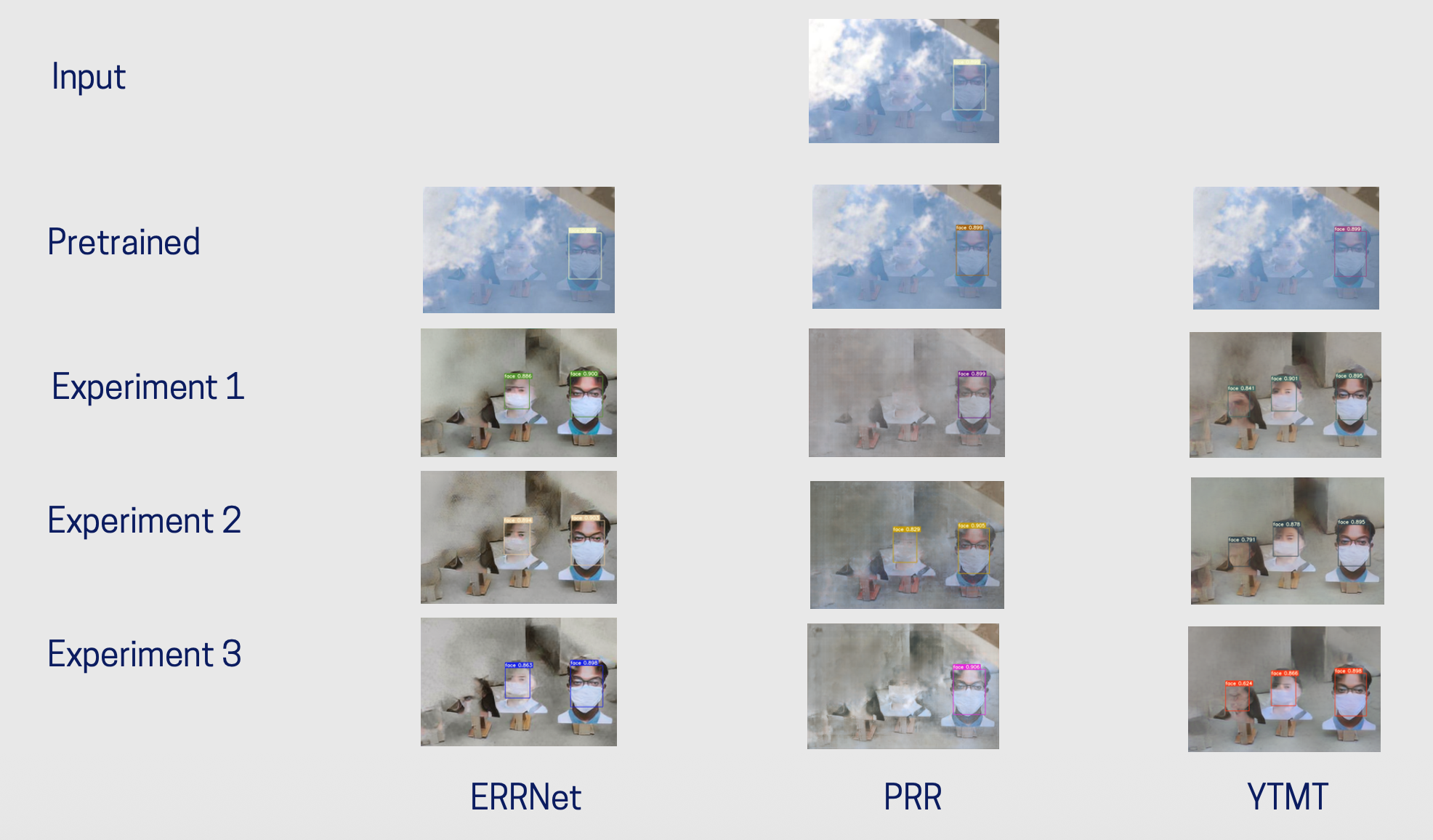
The research, “Reflection Removal and Facial Detection of Individuals in Vehicles,” utilizes Single Image Reflection Removal (SIRR) technology and Face Detection to remove reflections and reduce glare caused by automotive glass and film. This enables the capture of facial images of individuals inside vehicles. SIRR technology enhances image quality by removing reflections from the surfaces of glass that might obscure objects. In this research, we explore the use of three models specialized in SIRR and YOLOv7 for Face Detection. However, the pre-trained models for reflection removal failed to effectively remove reflections and reduce glare from films. In this paper, we propose an approach to enhance the efficiency of removing reflections and reducing glare caused by automotive glass and film with opacities set at 40% and 60%, achieving an impressive improvement in Peak Signal-to-Noise Ratio (PSNR) by approximately 42.96% and Structural Similarity Index (SSIM) by approximately 34.16% compared to the pre-trained models.